NASA, NFL Team Up to Showcase Space, Aeronautics Innovation

Football
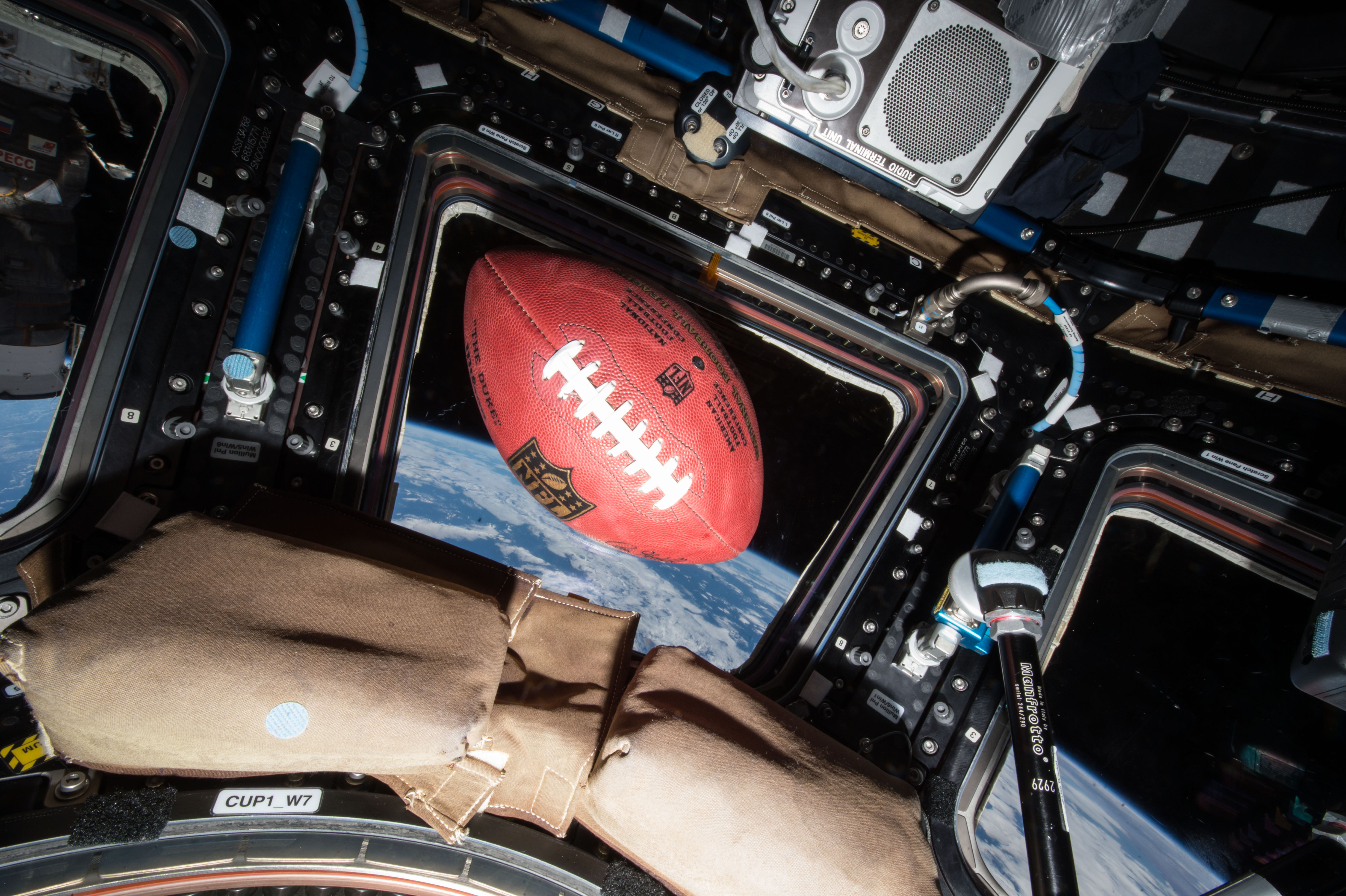
A football floats in microgravity aboard the International Space Station, high above the Earth.
Credit: NASA

Through a new collaboration between NASA and the National Football League (NFL), the agency will soon bring America’s strengths in space exploration and aeronautics innovation to the football field.

NASA will conduct flyovers, astronaut appearances, and fan engagement at NFL games across the United States as part of its new Inspiration Tour.

“This is the first season NASA is taking part in flyovers at NFL games, bringing the excitement of America’s space program directly to fans across the country,” said NASA Administrator Jared Isaacman. “We’re returning to the Moon, building a Moon Base, advancing fission-powered spacecraft, and pushing the boundaries in aeronautics, science, and discovery. Achieving those ambitions will take the very best of America, and partnering with the NFL gives us an incredible platform to inspire the next generation to look up and imagine the possibilities.”

NASA participation is targeted for the following games. Additional details will be released prior to each game, and more dates may be added:

  • 1 p.m., Sunday, Sept. 13: Pittsburgh Steelers vs. Atlanta Falcons in Pittsburgh
  • 1 p.m., Sunday, Sept. 20: Baltimore Ravens vs. New Orleans Saints in Baltimore
  • 1 p.m., Sunday, Oct. 4: Philadelphia Eagles vs. Los Angeles Rams in Philadelphia
  • 1 p.m., Sunday, Oct. 11: New York Jets vs. Cleveland Browns in East Rutherford, New Jersey

Flyovers scheduled at some of the games will showcase NASA’s fleet of aircraft, which are used for high-speed testing, high-altitude research, astronaut training, and more. Regularly flying the aircraft maintains the health of the fleet and publicly demonstrates new technologies that may be applied to future commercial air travel.  

With stops across the nation and led by Isaacman, NASA’s Inspiration Tour convenes academic, industry, and public sector stakeholders to connect the agency with the people, technologies, and organizations that drive American leadership in space.

The tour will culminate in MAX POWER, a public exposition of American air and space innovation, Nov. 7 and Nov. 8, on and near the agency’s Kennedy Space Center in Florida. Held in honor of America’s historic 250th anniversary, the multi-day, family-friendly event will showcase the next-generation aircraft, spacecraft, autonomous vehicles, and technologies that will help define the future of transportation in air and space.

For more information about MAX POWER and the agency’s missions, visit:

https://www.nasa.gov/maxpower

-end-

Camille Gallo / Jessica Taveau
Headquarters, Washington
202-358-1600
[email protected] / [email protected]

Details

Last Updated

Sep 10, 2026

Editor
Jessica Taveau

Related Terms

Source: www.nasa.gov

Dust and Water in Sagittarius A*

A dense star field fills the entire image, with countless stars scattered across a backdrop of glowing clouds in shades of red, orange, pink, white, and blue. At the center, a brilliant concentration of stars creates a bright, almost white core surrounded by intricate filaments and wisps of illuminated gas and dust that radiate outward. Dark, irregular patches of opaque dust interrupt the glowing clouds, particularly toward the left side of the image, where they appear as silhouetted shapes against the brighter background. The surrounding stellar population varies in brightness and color, with cool blue stars and warmer orange and red stars distributed throughout the scene.
ESA/Webb, NASA & CSA, F. Peißker, J. Lu, F. Yusef-Zadeh, N. B. Sabha, C. Chan

A brilliant concentration of stars takes center stage in this Aug. 11, 2026, image taken by NASA’s James Webb Space Telescope. Webb observed IRS 3, a star near the end of its life cycle, located within this starfield. Webb’s mid-infrared data revealed the clear signature of oxygen-rich silicate dust, as well as, for the first time, water, in its surrounding dust envelope.

Read more about this discovery.

Image Credit: ESA/Webb, NASA & CSA, F. Peißker, J. Lu, F. Yusef-Zadeh, N. B. Sabha, C. Chan

Source: www.nasa.gov
APOD: 2026 September 10 – LDN 1295: The Giraffe Nebula

APOD

Astronomy Picture of the Day

Discover the cosmos! Each day a different image or photograph of our fascinating universe is featured, along with a brief explanation written by a professional astronomer.

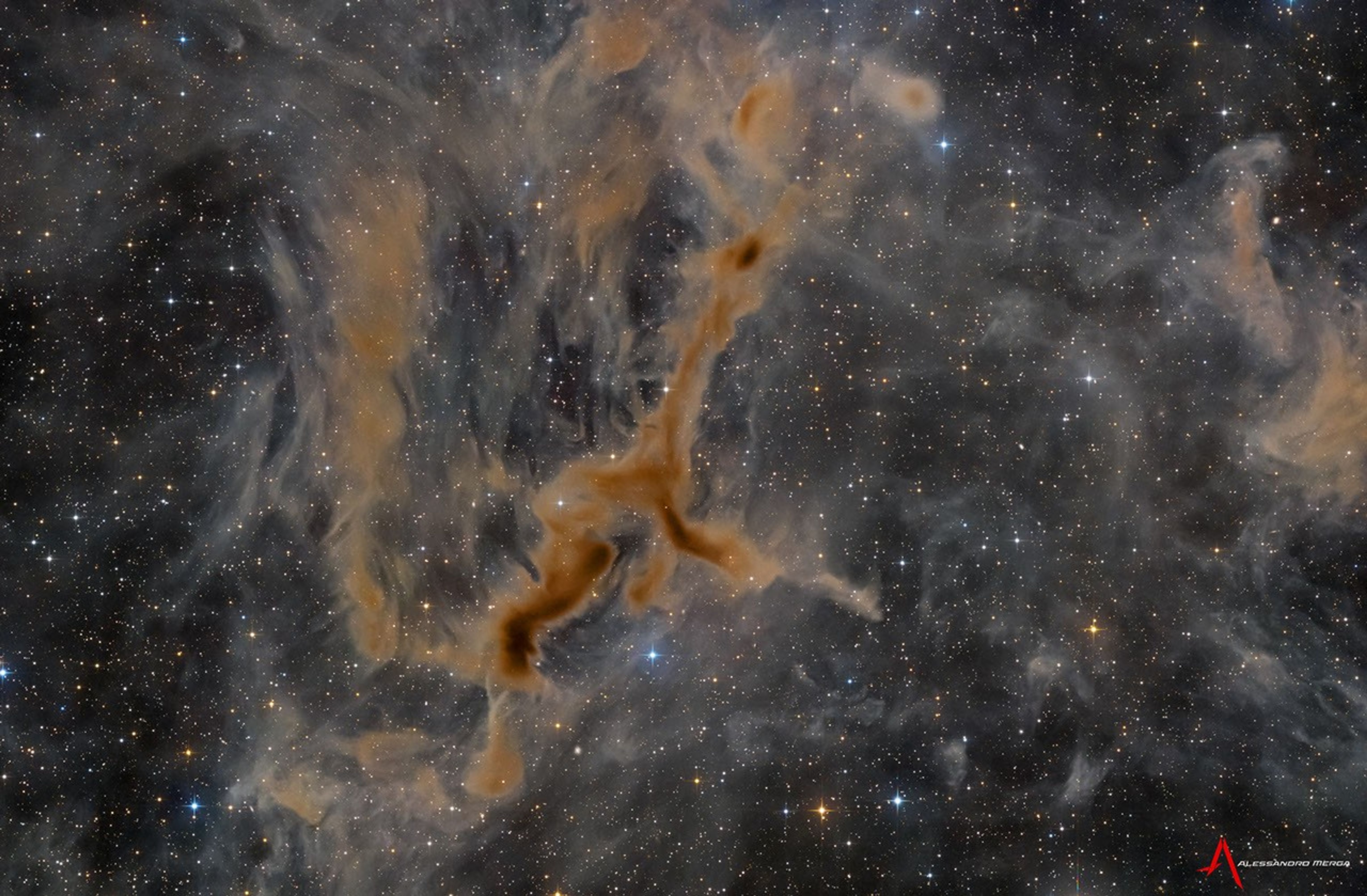
LDN 1295: The Giraffe Nebula

Explanation: What does this image look like to you? Many see a giraffe facing right, with neck stretched high and long legs mid-stride (but some may see a squirrel instead). The featured image shows LDN 1295, also called the Giraffe Nebula, in the constellation of the mythical queen of Aethiopia (Cassiopeia). It is an object in the Lynds Catalogue of Dark Nebulas, compiled in 1962 by American astronomer Beverly Lynds, a pioneer for women in astronomy and astrophysics. Dark nebulas are interstellar clouds of dust and gas that block the visible light of the stars behind them. These nebulas are often faint and challenging targets for astrophotographers. Why do we see animal shapes and faces in nebulas, clouds, and pretty much everywhere? It is due to pareidolia, our tendency to look for familiar patterns. Pareidolia may provide animals with an evolutionary advantage, for example in identifying (and avoiding) predators.

APOD’s main NASA site is moving : From apod.nasa.gov to science.nasa.gov/apod
Tomorrow’s picture: freewheeling

Date September 10, 2026
Credit & Copyright Alessandro Merga
Authors & editors: Cecilia Chirenti, Robert Nemiroff, Jerry Bonnell, Keighley Rockcliffe
A service of: ASD at NASA / GSFC,
NASA Science Activation & Michigan Tech. U.

Source: science.nasa.gov

NASA Adds Relativity Space’s Terran R to Launch Services Contract

NASA insignia.
Credit: NASA

A NASA Launch Services (NLS) II contract has been awarded by the agency to Relativity Space Inc., and its Terran R launch service in accordance with the contract’s on-ramp provision. The Terran R launch service will be available to NASA’s launch services to use for future missions.

The NLS II contracts are multiple-award, indefinite-delivery/indefinite-quantity contracts with an ordering period through June 2030 and an overall period of performance through December 2032. The NLS II contracts include an on-ramp provision that provides an opportunity annually for new launch service providers to compete for future missions and allows existing contractors to introduce launch vehicles not currently on their NLS II contracts.

The NLS II contracts support the goals and objectives of the agency’s Human Spaceflight Mission Directorate, Science Mission Directorate, and the Research and Technology Mission Directorate. Under the contract, NASA also can provide launch services to other government agencies, such as the National Oceanic and Atmospheric Administration.

NASA’s Launch Services Program Office at the agency’s Kennedy Space Center in Florida manages the NLS II contracts. For more information about NASA, visit:

https://www.nasa.gov

-end-

Joshua Finch / Jimi Russell
Headquarters, Washington
202-358-1100
[email protected] / [email protected]

Amanda Griffin
Kennedy Space Center, Fla.
321-593-6244
[email protected]

Details

Last Updated

Sep 09, 2026

Editor
Jessica Taveau

Source: www.nasa.gov
Steel and Stone: Army Corps of Engineers Reflects on 9/11 25 Years Later

To commemorate the 25th anniversary of 9/11, the National Museum of the United States Army opened an exhibit that chronicles what the Army and the Army Corps of Engineers did in the minutes, days and months following the tragedy to help the nation rebuild.

Source: www.war.gov

Curiosity Blog, Sols 4995-5001: 5,000 (Martian) Days on Mars

4 min read

Curiosity Blog, Sols 4995-5001: 5,000 (Martian) Days on Mars

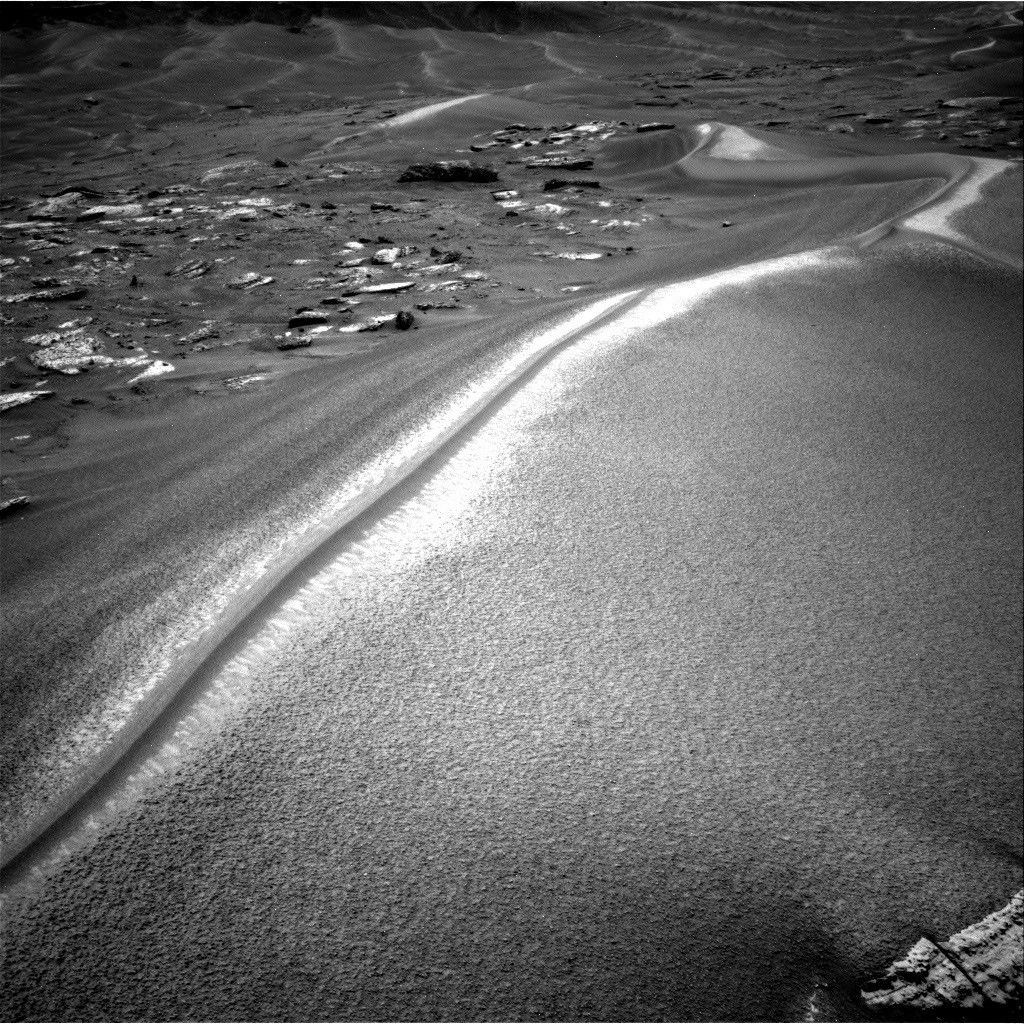
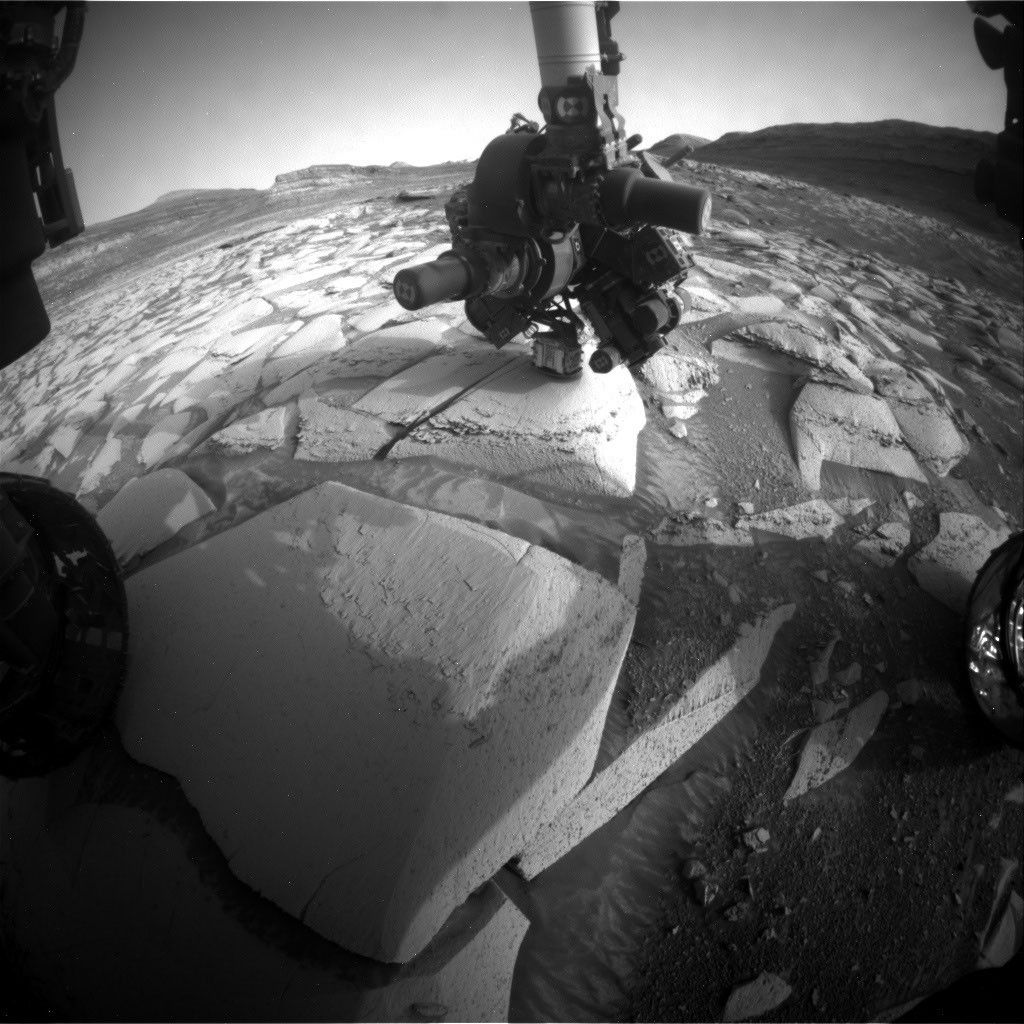
A black-and-white photograph from the Mars Curiosity rover showing a large, sweeping sand dune with a sharp, brightly sunlit crest. To the left are scattered flat rocks, and more rolling dunes stretch into the distant background.
NASA’s Mars rover Curiosity acquired this image along Chocolatal ripple using its Right Navigation Camera on Aug. 28, 2026 — Sol 4998, or Martian day 4,998 of the Mars Science Laboratory mission — at 13:58:36 UTC.
NASA/JPL-Caltech

Written by William Farrand, Senior Research Scientist, Space Science Institute

Earth planning date: Friday, Aug. 28, 2026

The span of sols spanned by this blog post is noteworthy in several ways. First, Curiosity became a world-class (for Mars at least) mountaineer by passing the 1 kilometer mark of elevation from its landing site on the floor of Gale crater. This writer was on the Mars Exploration Rover science team and we were excited when the Spirit rover got to the top of Husband Hill in Gusev crater in August 2005. But that was a climb of 106 meters (about 348 feet) above its landing site, and Curiosity has passed 1000 meters (about 0.62 miles). 

Second, Saturday, Aug. 29, marked 5,000 Martian days (or sols) since Curiosity landed on Mars (that’s more than 5,137 Earth days, because a day on Mars lasts 24.6 hours). Congratulations are in order to the engineers and scientists who have made this landmark possible. 

Finally, in terms of its science activities Curiosity is examining a wind-formed, long, narrow, large ripple which has been named “Chocolatal.” Further examination will help determine if this feature could be classified as a “transverse aeolian ridge” or TAR. TARs have been observed across the Martian surface based on orbital imaging. The long axis of a TAR is oriented perpendicular to the local predominant wind direction. While this is not the first potential TAR that has been examined by Curiosity, its location, higher on the slopes of Mount Sharp invites questions about whether it will be composed of the same types of granular materials found in the lower TARs, or whether it has a different range of grain sizes and/or layering. 

Other questions to be addressed include how the ridge formed, whether it is active, how it has migrated, and, if it is immobile, then how has it stabilized?

At the start of the planning week, Curiosity was en route to the sand ripple and encountered interesting science targets along the way. In Monday’s two-sol plan, in-situ examinations were planned of the light-toned bedrock occurring along the rover’s path. Some of the rocks encountered near the rover had dark-toned thick coatings or remnant layers, and these were targeted for chemical examination by the rover’s ChemCam Laser Induced Breakdown Spectroscopy (LIBS) instrument. Mastcam and ChemCam Remote Micro Imager (RMI) mosaics were planned, for layers in buttes along the rover’s path, and on more distant sets of sand ripples.

A midweek planning session took advantage of the last drive, leaving the rover only a few meters from Chocolatal. ChemCam was able to target sand at the base of Chocolatal as well as nearby bedrock. Stand-off Mastcam high-resolution image mosaics of the ripple were also targeted. The drive planned midweek took the rover right into Chocolatal with one of its wheels and then backing off a little, so in the end-of-week plan, contact science could be planned within the trenched region.

The final planning session of the week, which extended through the landmark Sol 5000, involved MAHLI mosaics of the right wall of the trench to see if there is layering, and to assess any variations in grain size. It’s noteworthy that these MAHLI mosaics are being named in honor of our late colleague Paul Geissler, who was one of the foremost experts on the study of Martian TARs and who was working with the MAHLI team before his untimely passing earlier in the year. In-situ APXS measurements were planned of the coarse-grained surface of the ripple, and ChemCam LIBS measurements were planned on the top of Chocolatal, a sinuous feature looking like a “mohawk” haircut (see the accompanying image). LIBS was also planned on a dark band on its flank and at the back of the scuff/trench. Other activities in the three-sol plan included Mastcam mosaics, an AM Navcam dust-devil survey, Navcam suprahorizon survey, and APXS atmospheric measurements.

With 5000 sols of outstanding scientific accomplishments, the Curiosity science and engineering team looks forward to the next 5000 sols.

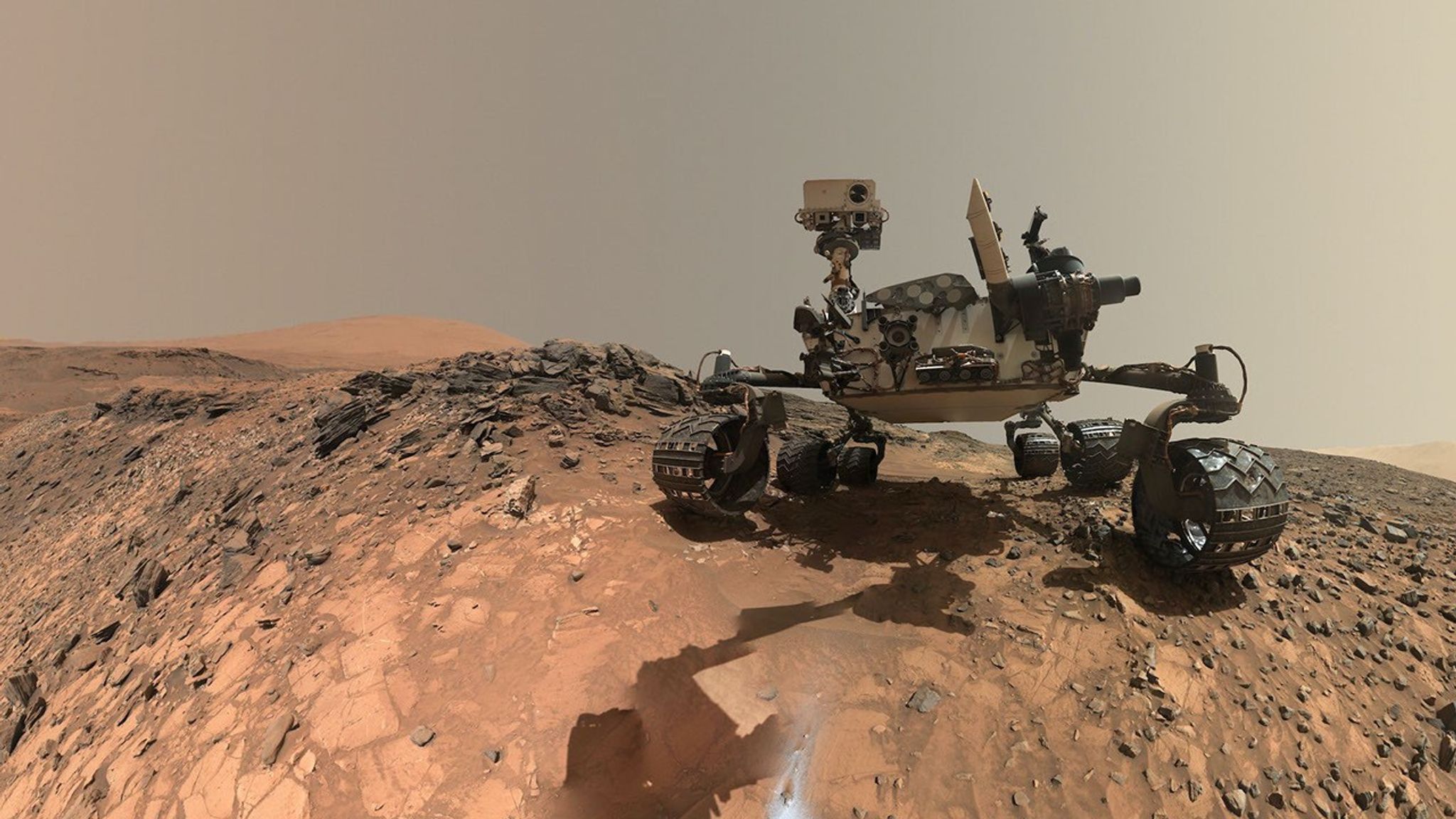
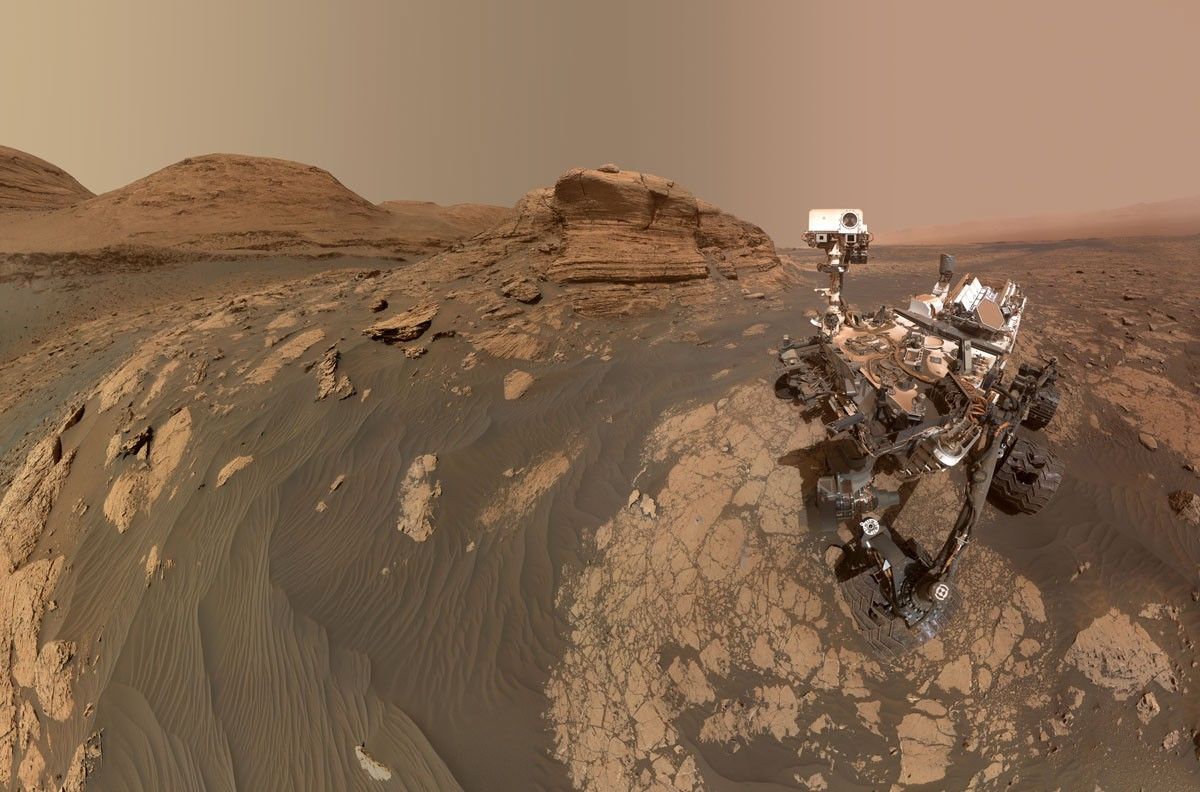
A rover sits on the hilly, orange Martian surface beneath a flat grey sky, surrounded by chunks of rock.
NASA’s Curiosity rover at the base of Mount Sharp
NASA/JPL-Caltech/MSSS

Details

Last Updated

Sep 09, 2026

Related Terms

Source: science.nasa.gov

Anak Krakatau Rumbles Again

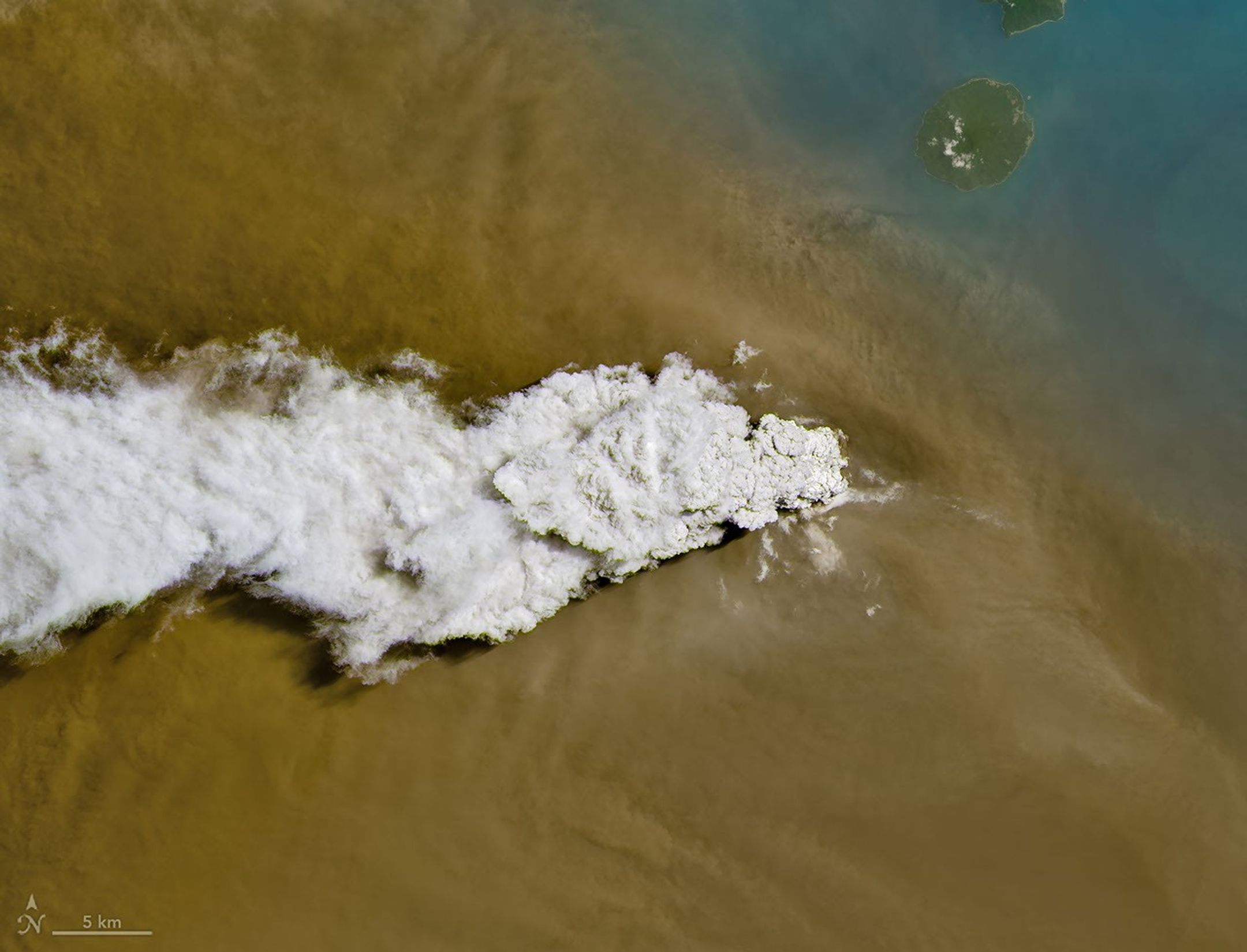
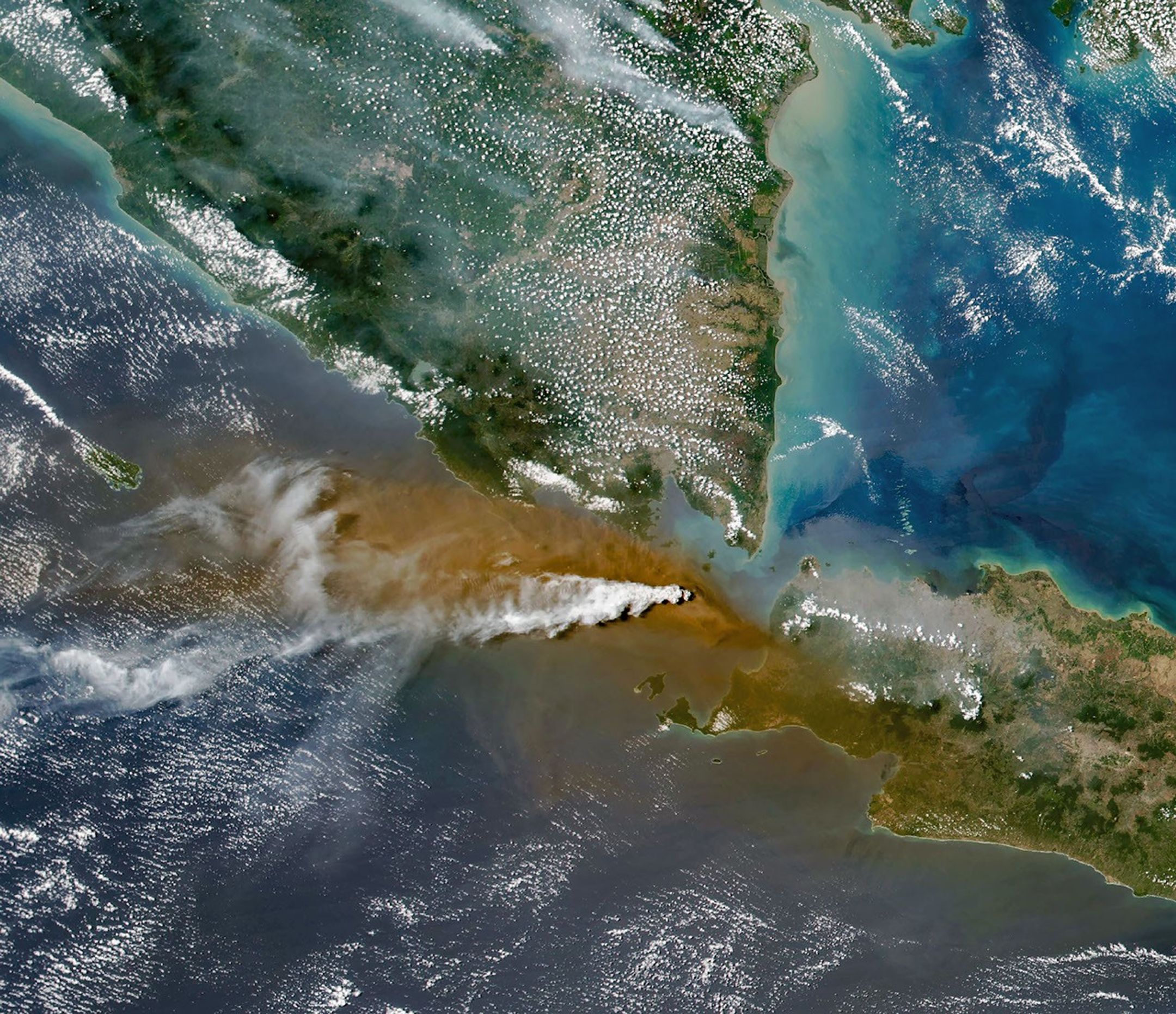
A white volcanic plume streams left over a tan ash cloud that fills most of the image. A small green island and blue water are visible in the upper right.
Anak Krakatau erupts ash and volcanic gases in this image acquired with the OLI (Operational Land Imager) on Landsat 8 on September 5, 2026.
NASA Earth Observatory/Michala Garrison

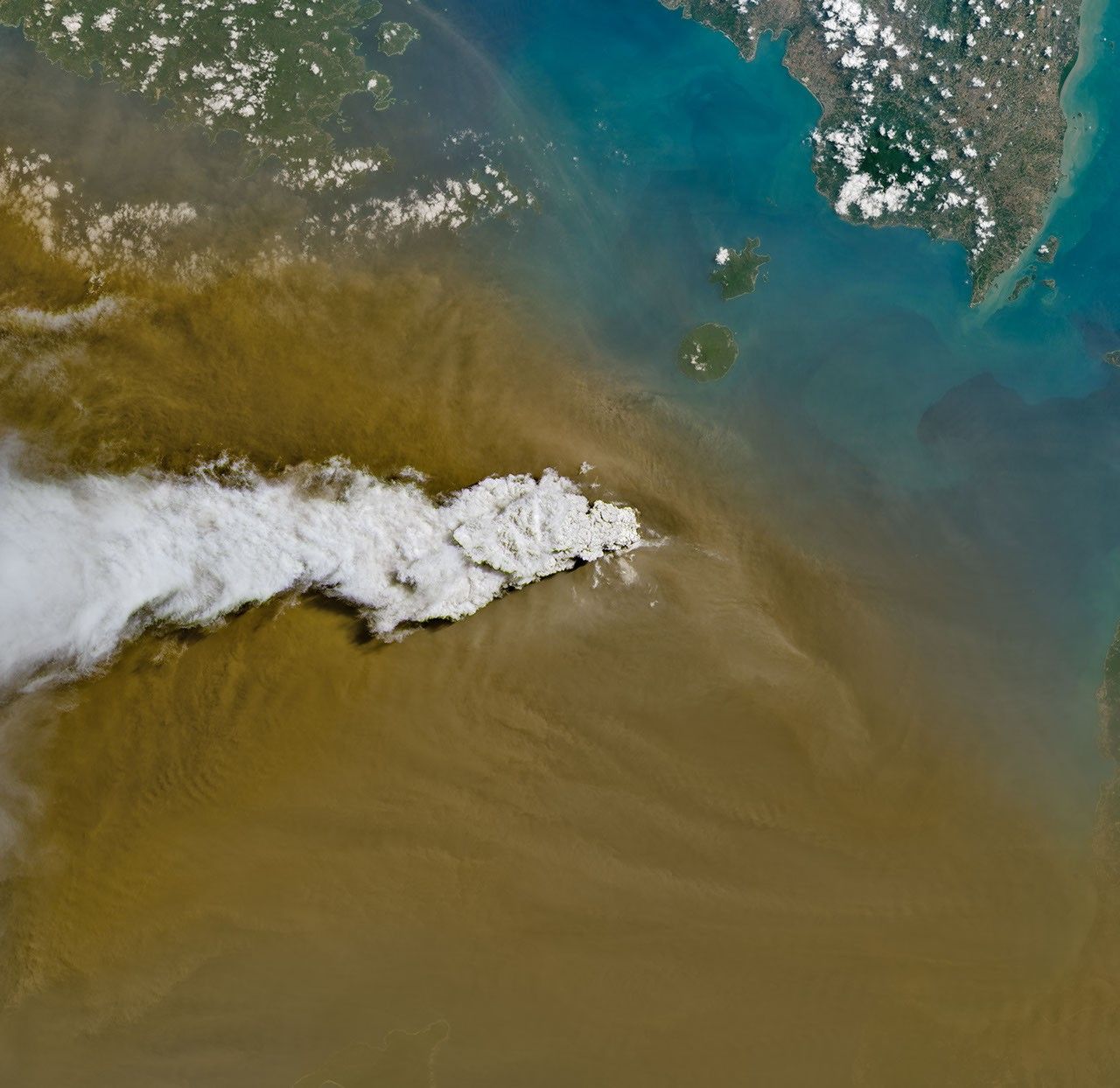
Eruptions are a regular occurrence at Anak Krakatau, a small volcano between the Indonesian islands of Java and Sumatra. Much of its activity remains relatively mild, but it occasionally puts on more impressive and hazardous shows of force. In early September 2026, a booming eruption lasting more than 24 hours sent gas and ash high into the atmosphere, disrupting thousands of flights and degrading air quality in parts of the country, including the capital city of Jakarta.

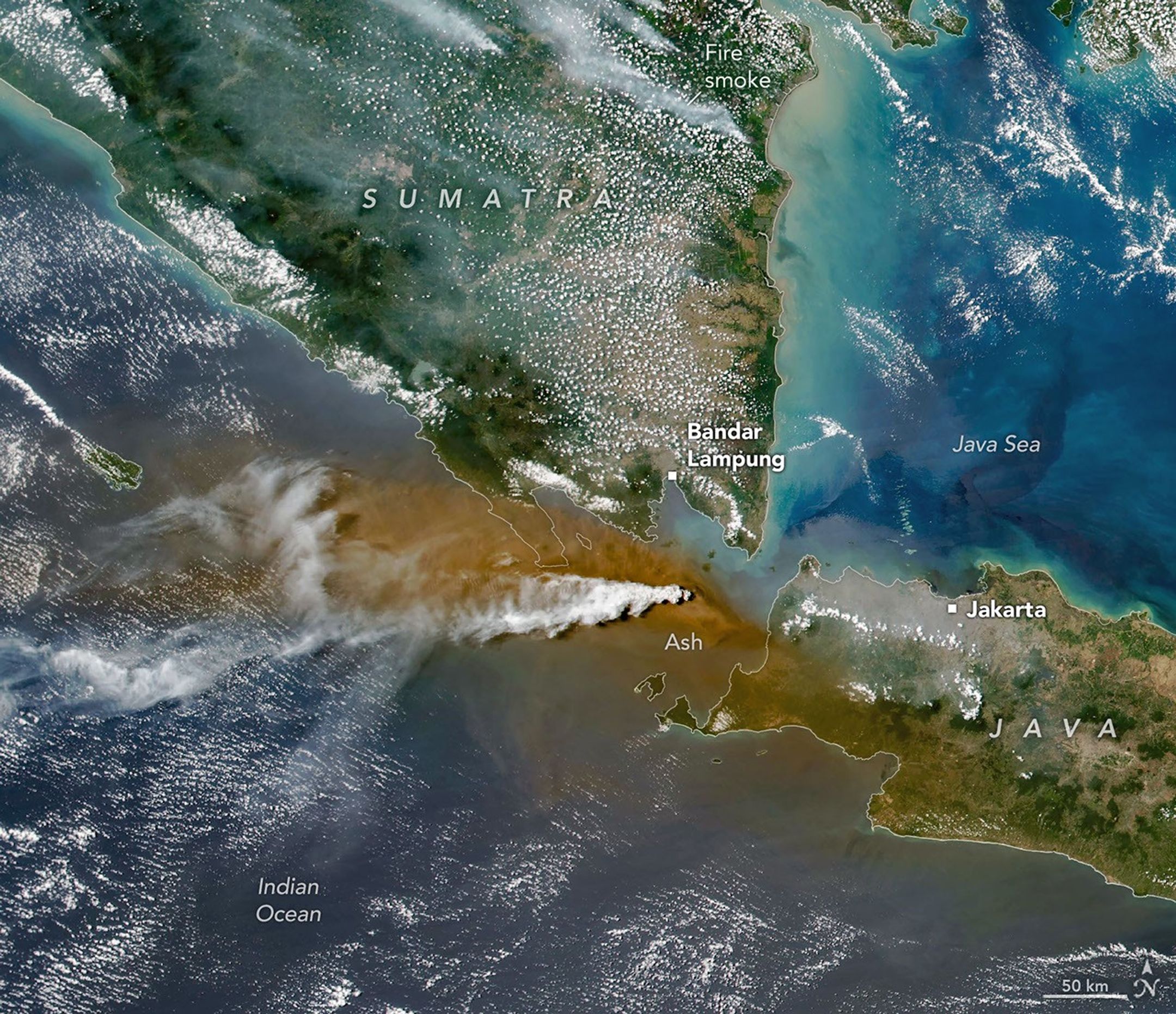
Satellites passing over the area during the eruption on September 5 captured images of the explosive activity. In the scene above, acquired with the OLI (Operational Land Imager) on the NASA-USGS Landsat 8 satellite, a white plume of volcanic gas billows over a brown ash cloud. Below, a wider view captured by the VIIRS (Visible Infrared Imaging Radiometer Suite) on the Suomi NPP satellite shows the volcanic material dispersing over a large area.

Indonesia’s meteorological agency reported that ash had reached altitudes up to 6,000 meters (20,000 feet) to the east of the volcano and 15,000 meters (50,000 feet) to the west by September 6. The presence of ash in the atmosphere prompted the temporary closure of eight airports on Java and Sumatra, disrupting nearly 3,000 flights in and out of the area, according to news reports.

A white plume streams to the left over a larger tan ash cloud, both coming from a volcanic eruption between the Indonesian islands of Java and Sumatra.
Plumes of ash and volcanic gases from Anak Krakatau drift over Indonesia and the Indian Ocean in this image captured by the VIIRS (Visible Infrared Imaging Radiometer Suite) on the Suomi NPP satellite on September 5, 2026.
NASA Earth Observatory/Michala Garrison

Ashfall affected populated areas, particularly to the east of Anak Krakatau in Jakarta and other parts of West Java, the Indonesian Humanitarian Coordination Platform (IHCP) reported. Volcanic ash poses health risks to people and can irritate the respiratory tract, eyes, and skin. However, this air quality hazard differs from the smoke produced by peatland fires elsewhere in the country in terms of particle characteristics, dispersal patterns, and protection measures, the IHCP noted. 

On September 6, the continuous explosive eruption from Anak Krakatau subsided, though the volcano kept rumbling. It returned to a more typical pattern of Strombolian eruptions, characterized by intermittent spurts of ash and volcanic material. Airports had resumed operation by September 8, but the volcano remained at the second-highest alert level on the country’s scale, as it has been since early July.

NASA Earth Observatory images by Michala Garrison, using Landsat data from the U.S. Geological Survey, and VIIRS data from NASA EOSDIS LANCE, GIBS/Worldview, and the Suomi National Polar-orbiting Partnership. Story by Lindsey Doermann.

References & Resources

You may also be interested in:

Stay up-to-date with the latest content from NASA as we explore the universe and discover more about our home planet.

Ever Restless Mount Dukono Erupts

2 min read

The volcano on Indonesia’s Halmahera Island routinely ejects ash, volcanic gases, and volcanic bombs.

Article

New Eruption in the Bismarck Sea

5 min read

Satellite imagery shows a surge of new volcanic activity in the ocean near Papua New Guinea.

Article

Melting Snow Off Shivelyuch

4 min read

Near-constant activity continues on the volcano in Russia.

Article

Source: science.nasa.gov

From the Corps to the Cosmos, featuring Jaden Caradine

Jaden Caradine knew he wanted to be an engineer at eight years old. He just took a winding road to get there.

Before he enrolled at Embry-Riddle Aeronautical University, before he discovered the field that would become his focus, and before he landed a Pathways internship at NASA’s Langley Research Center in Hampton, Virginia, Caradine spent five years as a mechanic in the United States Marine Corps, four of them stationed in Japan. It was a deliberate detour, one that shaped how he approaches everything since.

“I’ve kind of always known I wanted to be an engineer,” he says. “I just had to figure out what kind.”

Jaden Caradine, NASA Pathways intern, at NASA Langley Research Center
NASA Pathways intern Jaden Caradine
Credit: NASA

Finding the Overlap

Caradine grew up in the Salt Lake City area, raised by a mother who put him on a snowboard at four and on a rock face not long after. He was the kind of kid who learned to love science not for its own sake, but for what it could do. “Math is an enabling skill,” he says. “It’s not about doing the math. Math has a purpose and it’s useful.”

By the time someone asked young Jaden what he wanted to be, the answer was immediate. “I was building Legos,” he says, “and I just thought — I want to build stuff. I can’t really see myself being anything other than an engineer.”

Right out of high school, Caradine enlisted in the Marines, trained as a mechanic, and shipped out to Japan. During those five years, between the technical work and the distance from home, he started reading books on decision-making, career planning, and long-term thinking. He found a framework he keeps coming back to: ikigai, a Japanese concept that maps the intersection of what you’re good at, what you enjoy, what the world needs, and what you’re paid to do.

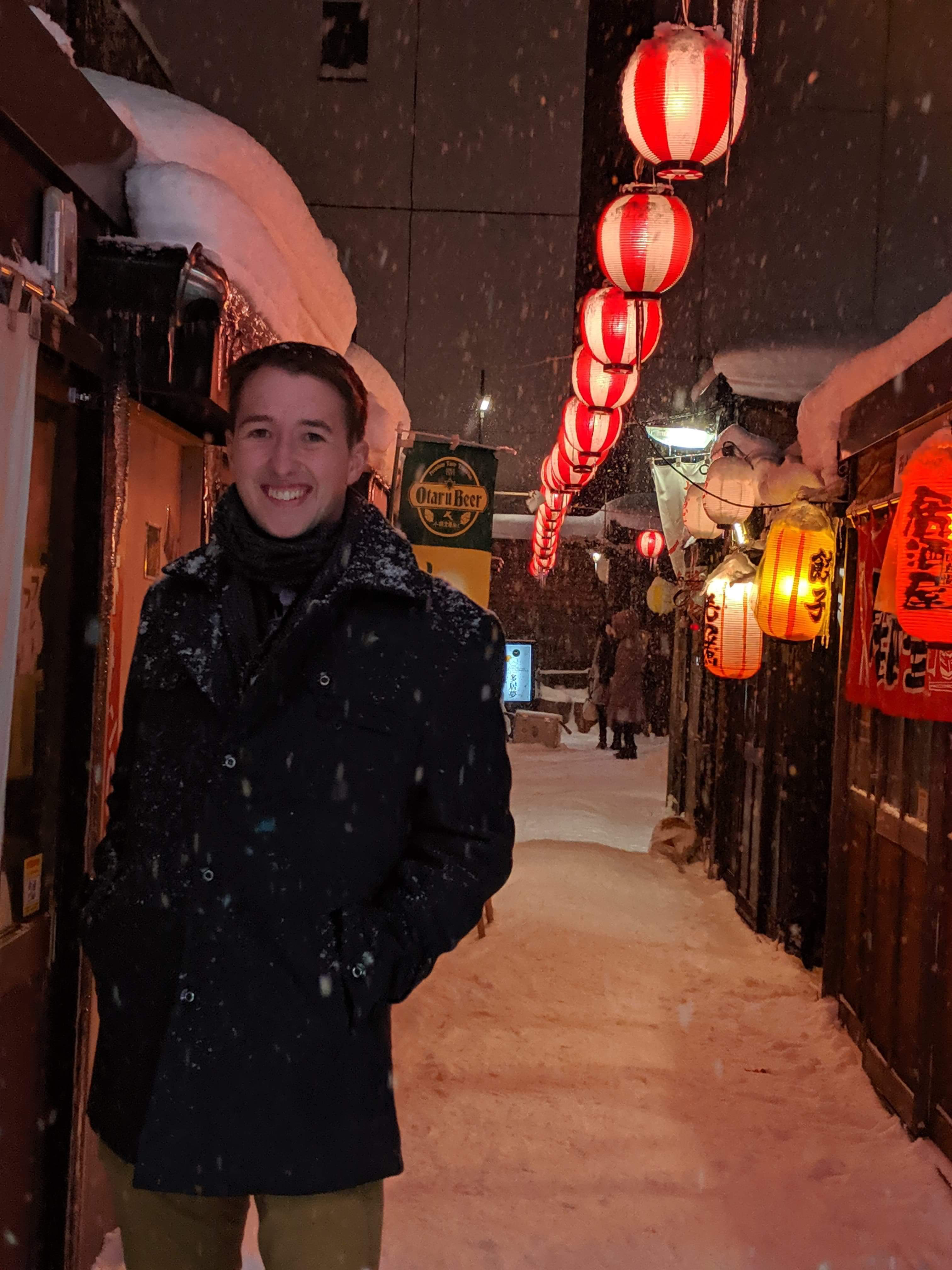
Jaden Caradine at the Sapporo Snow Festival in Hokkaido, Japan, during his service as a U.S. Marine
Caradine at the Sapporo Snow Festival in Hokkaido, Japan, while serving as a U.S. Marine
Credit: Jaden Caradine

“Your ikigai is the thing where all of those overlap,” he says. Engineering was already in the picture. The question was what kind.

Chasing the Signal

The answer arrived through research and a company Caradine stumbled on while scanning the landscape of emerging aerospace technology. They were using magnets to spin a launch system to 14,000 or 15,000 RPM and release small satellites into orbit, recovering the energy on the way down through the same magnetic system. “I thought that was awesome,” he recalls. “So, I started looking into aerospace engineering, and it was a good fit.”

Once he had the field, the destination wasn’t hard to find. Caradine transferred to Embry-Riddle Aeronautical University’s Daytona Beach campus to study aerospace engineering and immediately started showing up everywhere he could — satellite conferences at Kennedy Space Center, industry events in Orlando, small satellite gatherings back in Salt Lake City. “I went to all the career fairs, even though I wasn’t looking for a job yet,” he says. “I just wanted to learn as much as I could, as fast as I could.”

At every NASA booth, he asked questions. He learned about Pathways, the program that places undergraduate and graduate students at NASA centers with the potential to convert to full-time civil service positions, but he waited a year to apply. “I hadn’t really done the things I wanted to do in order to write a strong application yet,” he says. He wrote the next application with the intention of using it as a practice run. He got in.

His reason for choosing NASA over industry was simple and firm. “NASA doesn’t work for profit,” he says. “We’re here to remove barriers so that industry can eventually do the things they weren’t able to do before.”


“Human beings are far more capable than we give ourselves credit for. A journey of a thousand miles starts with a single step and can only be taken one step at a time.”


Work Worth Doing

At NASA Langley, Caradine is part of the Systems Analysis and Concepts Directorate, where “we help agency leaders figure out why they should make certain decisions, especially those that have lots of moving parts,” he explains. Specifically, he works with the in-space servicing, assembly, and manufacturing (ISAM) team, a group focused on the emerging field of building and maintaining infrastructure in space, rather than simply launching and discarding it.

A major part of his summer was curating the State of Play, a comprehensive document that consolidates everything happening in the ISAM sector across government, academia, and industry into a single, navigable resource.

“Jaden joined the team and immediately contributed to this year’s State of Play update,” says Dale Arney, aerospace engineer and Caradine’s mentor. “He also created an automated tool that will help the team create future updates more quickly.”  

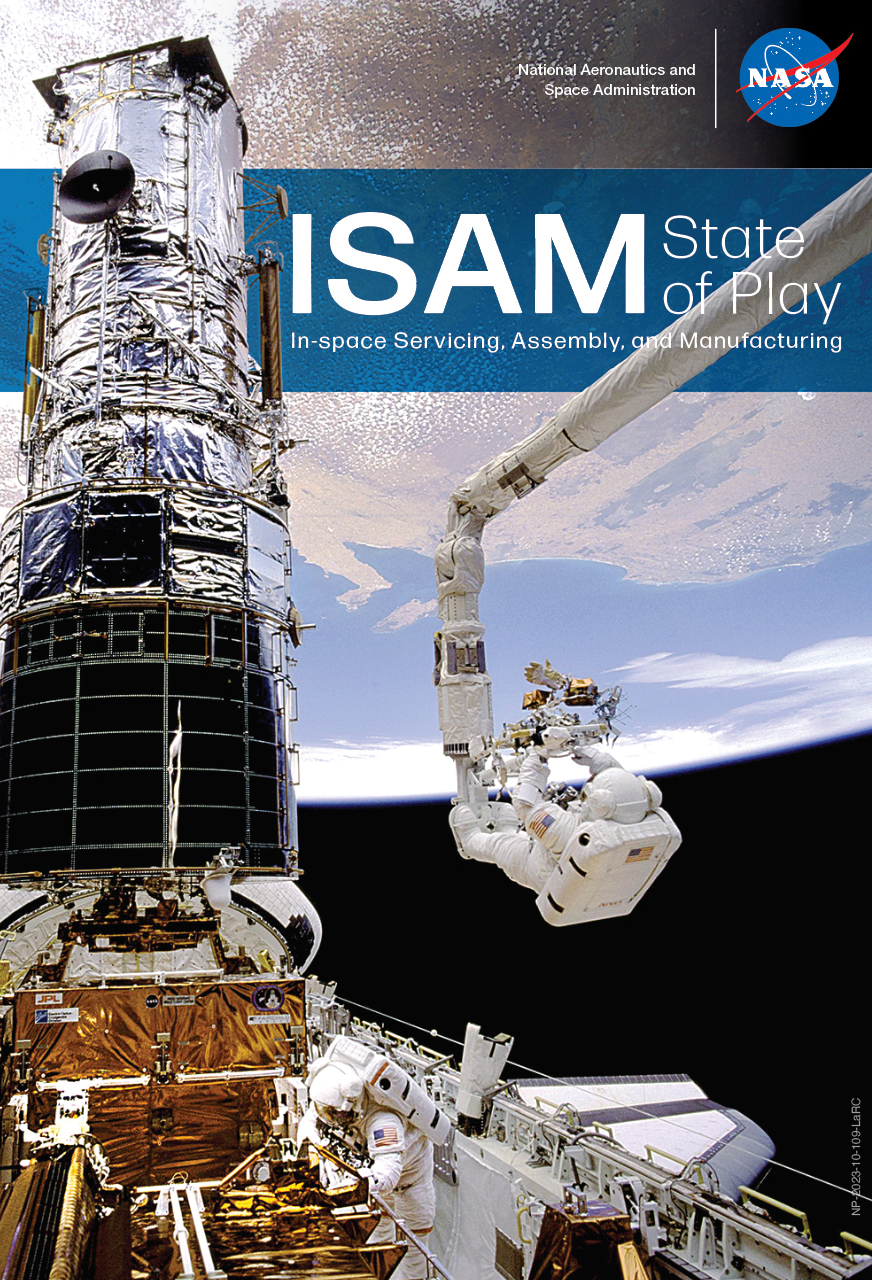
Cover of NASA's ISAM State of Play document, a survey of in-space servicing, assembly, and manufacturing capabilities across industry, academia, and government
The ISAM State of Play document is a survey of past, present, and near-future ISAM capabilities across industry, academia, and government agencies.
Credit: NASA

That tool scrapes aerospace news from across the web, compiles relevant updates into organized tables, and produces a readable summary on a regular cadence. “It kind of replaced the need for everyone on the team to spend 30 or 40 minutes every day scrolling through news to keep up,” he says.

“Jaden was constantly looking for ways to improve himself, the team, and our products,” Arney adds. “He was eager to take the lead in trying a number of new processes and ideas to try to make them work for us.” 

No Silos

The thing that surprised Caradine most about NASA Langley had nothing to do with the technical work. He had expected some departmental siloing that could develop in large organizations, where people become experts in narrow areas with limited cross-pollination among teams.

“That’s not something I’ve experienced here,” he says. “We all talk to each other, across all teams. We share resources. We collaborate quite extensively.” He describes a culture that expects everyone to engage with the whole problem, not just their corner of it. “Everyone kind of bounces around on different teams to learn the whole aspect of the problem and support each other.”

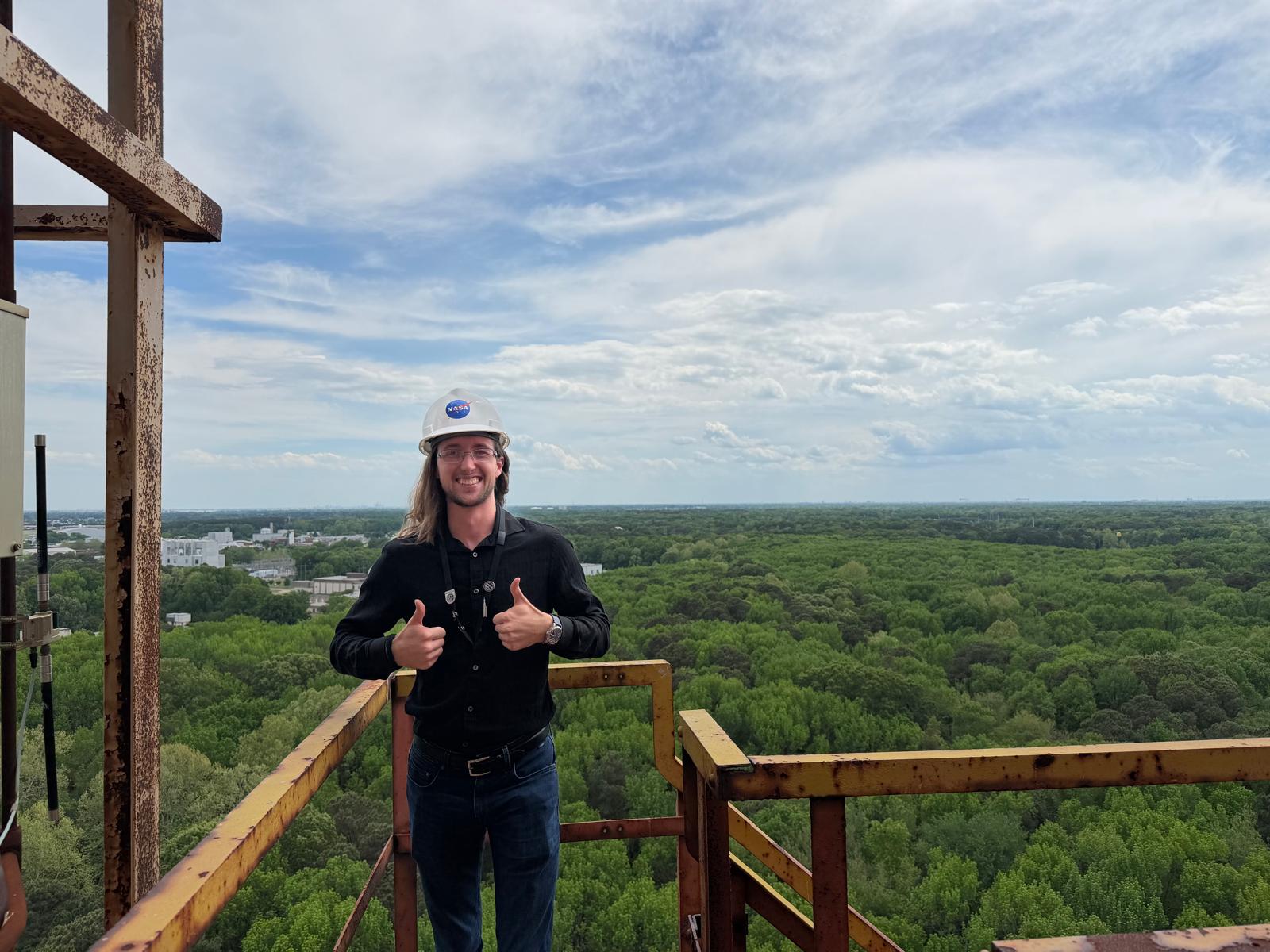
Jaden Caradine standing atop the gantry at NASA Langley's Impact Dynamics Facility
Caradine at NASA Langley’s Impact Dynamics Facility, enjoying the view at the top of the gantry
Credit: NASA

For anyone considering the Pathways program, his advice is direct. “Do it,” he says. “Human beings are far more capable than we give ourselves credit for. If it seems like too much, break it down. A journey of a thousand miles starts with a single step and can only be taken one step at a time.”

Caradine heads back to Embry-Riddle as a junior this fall, with plans to return to Langley next summer. Grad school is on the horizon, and he’s exploring programs that nurture important analysis skills for SMAB, including decision, strategic, and systems analysis.

“Before coming here, I was trying to do everything and cast a wide net,” he says. “Now I know what I need to know how to do. That’ll give me the opportunity to focus my efforts on the high-value skill sets.”

On Caradine’s Sci-Fi Shelf

The Sirens of Titan by Kurt Vonnegut

Dungeon Crawler Carl by Matt Dinniman

Caradine’s instinct runs more toward fantasy than science fiction, but this one, he says, hits something real.

“I enjoy the leveling aspect — constantly improving, constantly getting better. In books it might be physical strength, but in reality, strength takes on many different forms. Constant improvement is quite rewarding in real life, as it is in books.”

The audiobook production, he adds, is its own experience: full sound design, character actors, the works. “It’s like listening to a movie.”

The team also recently convinced him to start Dune, by Frank Herbert. He’s about halfway through.


Part of the Systems Analysis and Concepts Directorate at NASA’s Langley Research Center.
Learn more about our work by visiting our website.

Source: www.nasa.gov